
Download this complimentary White Paper today!
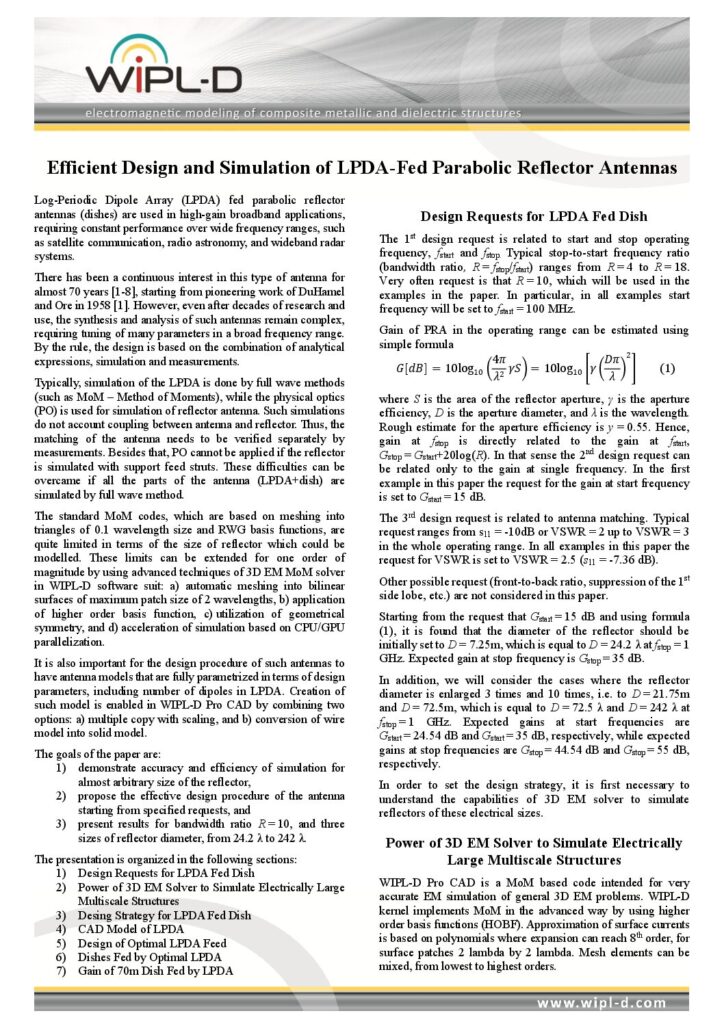
This white paper provides antenna and RF engineers with a practical design methodology for wideband, high-gain LPDA-fed reflector antennas, combining advanced Method of Moments techniques and smart symmetry techniques, from initial specifications through full-wave 3D electromagnetic simulation of electrically large structures.
What you will learn about:
- How to establish design requirements for LPDA-fed reflector antennas with a bandwidth ratio of R = 10, including gain targets from 15 dB to 55 dB and VSWR constraints across a 100 MHz to 1 GHz operating range.
- Why advanced MoM techniques — higher order basis functions, quadrilateral meshing, symmetry exploitation, and CPU/GPU parallelization — extend simulation capability by an order of magnitude over traditional low-order implementations.
- How a systematic three-step design strategy (stand-alone LPDA optimization, reflector integration, and combined parameter tuning) delivers reliable broadband performance while managing mutual coupling effects between the feed and reflector.
- How parametric CAD modeling with self-scaling geometry, automated wire-to-solid conversion, and Field Generator excitation accelerates design iteration and enables efficient simulation of even 70 m dishes on standard desktop hardware.
Click “LOOK INSIDE” to Download Now.
IEEE Spectrum and Wiley are proud to bring you this white paper, sponsored by WIPL‑D.
More Information
Log-Periodic Dipole Array (LPDA) fed parabolic reflector antennas serve high-gain broadband applications such as satellite communication, radio astronomy, and wideband radar, where constant performance over wide frequency ranges is essential. Despite nearly seven decades of research since the pioneering work of DuHamel and Ore in 1958, the synthesis and analysis of these antennas remain complex, requiring the tuning of many parameters across broad bandwidths. Traditional simulation approaches — combining Method of Moments for the LPDA with physical optics for the reflector — cannot account for mutual coupling between the feed and dish, and break down when support struts or electrically large reflectors are involved. This white paper presents an advanced full-wave simulation methodology using higher order basis functions that reduces unknowns by an order of magnitude compared to conventional MoM, demonstrates a practical three-step design strategy from stand-alone feed optimization through full antenna integration, and provides validated results for reflector diameters ranging from 24.2 λ to 242 λ with bandwidth ratios of 10:1 — all executed on standard desktop hardware with CPU/GPU acceleration.
Sponsored by

Partnered with

IEEE Spectrum Magazine, the flagship publication of the IEEE, explores the development, applications and implications of new technologies. It anticipates trends in engineering, science, and technology, and provides a forum for understanding, discussion and leadership in these areas.