
Register now free-of-charge to explore this white paper
This Whitepaper offers engineers and researchers a technical examination of the key design barriers in humanoid robotics and the component-level strategies emerging to address them, from sensing and motion control to power systems and thermal management.
What you will learn about:
- The core engineering challenges — complex motion control, safe human-robot interaction, and hardware cost constraints — that currently limit practical humanoid robot deployment.
- Sensing system architectures: how IMUs, gyroscopes, accelerometers, tactile sensors, and AMR magnetic sensors support real-time posture estimation, perception fusion, and environmental awareness.
- Motion and actuation design considerations including actuator-level power delivery, motor noise mitigation, PCB bend-stress resistance, and dexterous hand integration.
- Power and thermal system trade-offs: battery chemistry selection (LFP vs. NCA), BMS design, DC/DC converter topologies, and thermistor-based protection for operational reliability.
Click ‘LOOK INSIDE’ to Download Now.
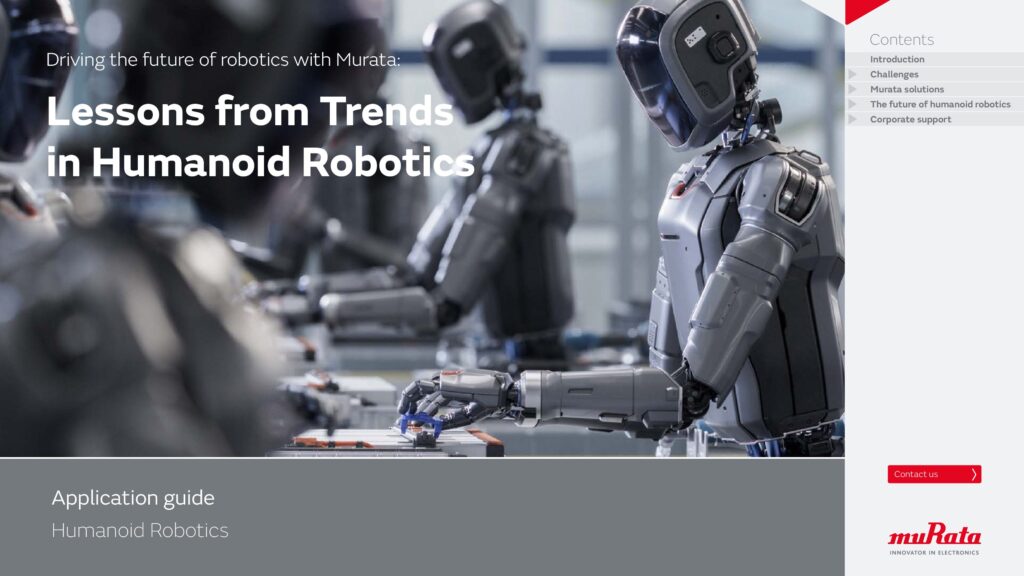
IEEE Spectrum and Wiley are proud to bring you this white paper, sponsored by Murata Manufacturing Co.
More Information
Humanoid robotics is advancing rapidly, yet engineers continue to face formidable barriers in locomotion stability, real-time perception, safe human interaction, and power-constrained hardware design. As the industry approaches a projected shift from small-scale prototyping to mass commercialisation in the late 2020s, understanding the component-level decisions that affect system reliability, cost, and performance is becoming critical. This guide examines the technical landscape across sensing, motion, control, and battery subsystems — outlining the design trade-offs, modular architecture trends, and supply chain considerations that will shape the next generation of deployable humanoid platforms.
Sponsored by
Partnered with

IEEE Spectrum Magazine, the flagship publication of the IEEE, explores the development, applications and implications of new technologies. It anticipates trends in engineering, science, and technology, and provides a forum for understanding, discussion and leadership in these areas.